
What Makes Readers Pay For Substacks?
Permission to let go + 7 key takeaways

Hello lovely reader,
Today’s post is about what encourages readers to pull out their credit cards and subscribe to a Substack publication.
It includes the results of the poll I ran last month.
I’m not here to give you a full lecture on the neuroscience of purchasing decisions - although I do recommend reading up on that if you’re serious about making mega-bucks on Substack - instead, I want to share a few juicy tidbits I’ve discovered while growing my other publication to a Substack bestseller, as well as takeaways from my recent poll.
3 types of Substack subscribers
When I first launched paid subscriptions on Substack in my other account (in 2022), I had a theory that there is a certain type of person who just wouldn’t pay for a subscription, no matter what I promised them.
Just. Won’t. Pay.
It’s kind of a personal policy: some people just say “Subscriptions = no way”
(Except maybe Netflix. And Amazon Prime. And some cloud storage. And…. you get the picture…)
To test my theory about the “No way” people, I surveyed my readers - I had around 1,000 at the time - and asked them what I would need to do to get them to upgrade to a paid subscription.
For forty percent of them, the answer was nothing: there was nothing I could offer that would ever convince them to get their credit cards out for my food safety publication.
The other sixty percent were split between “Give me access to awesome resources” and “Let me support your work”.
In a nutshell, I had discovered there were 3 types of potential subscribers:
“No way, never” subscribers
“I need to get special content” subscribers
“I want to support your efforts” subscribers
This was great information, because it allowed me to rethink my conversion strategies.
No such thing as perfect
After I discovered that I had a large bunch of readers who would never become paying subscribers, I stopped hustling to find the ‘perfect’ paid offer. It was kind of a relief to know that for those people, I could never convert them by offering them more or better resources.
This meant I could spend less time questing for perfection for everyone and more time appealing directly to the readers who MIGHT want to pay.
Even better, once I realised there were two types of potential paying subscribers for that newsletter, I knew I needed to tweak my conversion strategy.
These days I split my ‘Upgrade to paid’ CTAs (calls to action) between “Become a paying subscriber to get [amazing resources/special content]” and “Become a paying subscriber to support my efforts to bring you the best [content] every week”.
When I added the second style of CTA to my posts, my publication’s conversion rate almost doubled.
What’s changed for Substack readers?
It’s all very well for me to talk about a poll I ran in 2022 for food safety professionals. What about everyone else on Substack? We’re all here for different reasons, and times have changed since 2022.
Last month, I published a post to find out what you guys, the readers of Pubstack Success, think about paid subscriptions. My aim: to collect data to help you strategise for your publication.
In it, I asked four questions using Substack’s Poll feature. Here are the results, followed by 7 key takeaways.
Results of the 2025 poll
Question 1: Do you pay (at all)?
You’re a generous lot! People who responded to this poll are generally willing to pay for subscriptions, with just 8% saying they will “never pay”.
92% are either already paying or open to it.
68% are currently paying, and
21% of you pay for more than 3 publications!

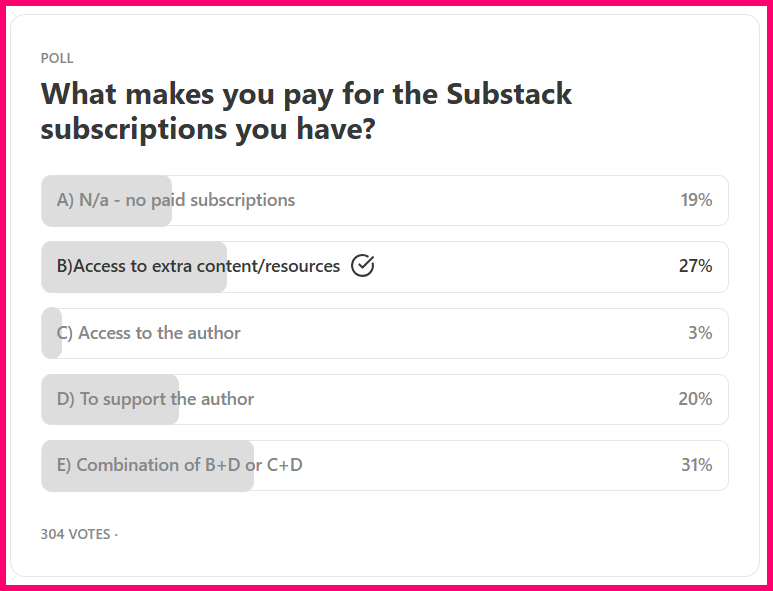
Question 2: Why do you pay?
Around 30% of you chose “access to extra content/resources” as the only reason you pay, with a further 30% choosing a combination that “resources” and “support the author”.
The proportion of people who say they pay for “access to the author” alone is tiny at 3%.
Taken together, about three‑quarters of people who pay are doing it for some mix of extra content/resources and to support the author, not for access or altruism alone.
Question 3: Pricing for work or business newsletters
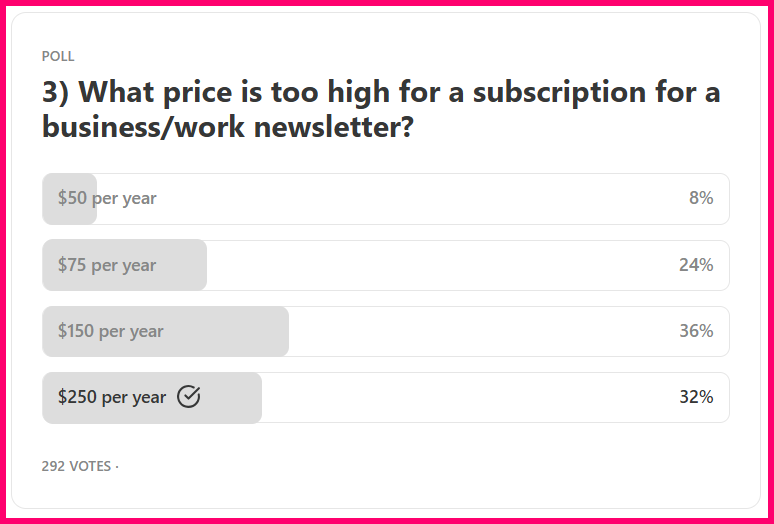
Almost everyone (92%) is fine with $50 per year for a work or business newsletter, but one quarter of respondents think $75 per year is too much to pay.
Around one third of you are okay with pricing up to $150 per year and some of you would be willing to pay even more than that.
The results suggest the majority of readers are willing to pay $80–$140 per year for work or business newsletters.
Question 4: Pricing for leisure, culture, fiction or hobby newsletters
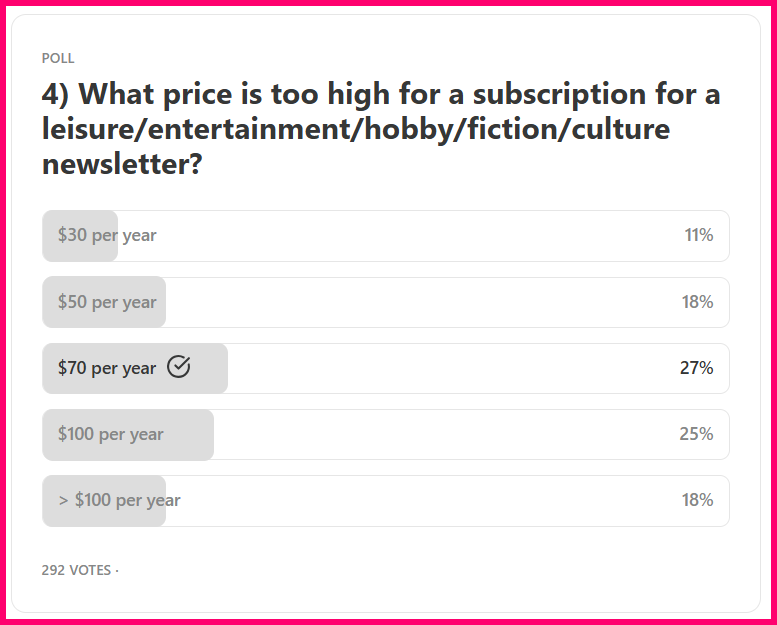
Most of you (89%) think $30 per year is acceptable, and more than two-thirds (71%) are fine with up to $50 per year for a leisure, culture, fiction or hobby newsletter.
The most popular response was that $70 is too much. However, around one in five of you (18%) are willing to pay more than $100 per year.
The results suggest $50-$60 per year is the sweet spot for most non-work newsletters.
Key Takeaways
Some people just won’t pay, no matter how much ‘value’ you offer. This could be because of their personal policies, personal finances or because they feel like they’ve already got too many other subscriptions. That is: it’s not you, it’s them.
Readers will upgrade to a paid subscription for access to specific resources and extra content more readily than for access to more of the same type of content or access to the creator.
In addition, many people like to feel they will be supporting the author with their subscription, rather than just paying to get something. Lean into this in some of your calls to action (E.g. “Upgrade for early access to this month’s chapter and feel great knowing you’re supporting independent writing”)
Pricing tolerance is higher for work or business newsletters. If readers can justify a subscription as a business expense or a tool that saves them money or time, they will be willing to pay more. If the value is entertainment, cultural or aesthetic, most will be willing to pay less.
My poll results suggest the following price points are safe/’no-brainer’ options for most newsletters:
$80–$140 per year for work or business newsletters and
$50-$60 per year for most non-work newsletters.
For monthly prices, use 10% of the annual price as a starting point, and test slightly higher and lower options.
Use the ‘Founder’ tier to accommodate superfans who want to pay more.
Okay that’s it for now. Stay safe, stay merry and stay sane this week,
Karen
P.S. You might also be interested in…
How to Beat the Paid $ubscription Blues

Three things you can do today to move the dial on your paid conversions
Thanks Karen for sharing the interesting data 📊 certainly helps. I’m grateful for you contributing to my new Substack in 2025. I’m glad we found each other. Merry Christmas and Best wishes for 2026 & beyond! 😊
Ok this was hugely helpful, as I was paining over what kind of content to offer as a paid feature! Very few are doing the combination that I offer as well so it makes it that much more challenging to configure. Thank you!✨