
$27K on Substack: What I've Learned
While writing in a weird niche

This is Pubstack Success, a weekly newsletter about how to succeed on Substack from someone who’s done it without writing about writing. Welcome.
Lessons learned on my way to $27K.
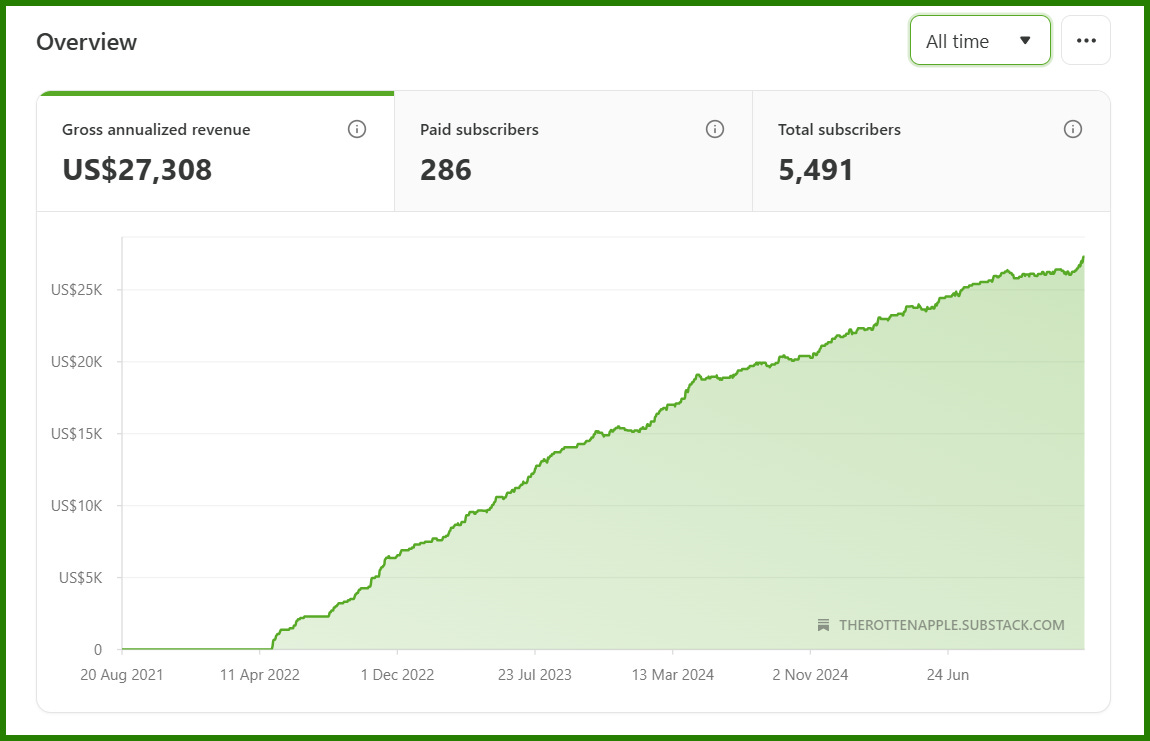
I’m celebrating a milestone in my other newsletter this week:
225 weeks of publishing
255+ paying subscribers
$27K+ yearly revenue on a part-time basis
It feels amazing to earn meaningful money doing what I love every week. So I wanted to share how I got here and describe some of the things that have contributed to my success.
Before you say $27K is not ‘success’, let me share my experience of being selected by Substack to join the invitation-only Substack Growth Intensive in 2022. A few people in that group were making really good coin. Most of us were not.
When we started, almost none of us had conversion rates (free to paid) greater than two per cent, even though Substack will tell you that five to ten per cent conversion rates are the norm.
Anyone earning more than $2K per year on Substack is a rarity. And I feel blessed to be among them.
How did I get here?
I quit my corporate job in food safety in 2021 to go all in on a side-hustle I’d started while my kids were young.
The aim: build a business that would support the lifestyle I wanted: freedom to travel, freedom to choose when I worked, freedom to work from anywhere.
At the time, I was doing consulting work and writing articles that drove organic traffic to my food safety website, where I sold tools, templates and training.
Compared to consulting, writing was much more fun: I could do the work when it suited me, instead of working to a client’s schedule. Plus, it was generating income by drawing customers to my website, where they would purchase digital products.
I wanted more. More passive income from writing.
Enter Substack.
Substack and its paid subscription model seemed a perfect additional income stream for my business: I could write from anywhere and my newsletter would generate steady income, even in months that are slow for consulting gigs.
I started a publication with the main goal of making extra money for my business in just one day per week. There’s more to it than the dollars, of course… I also want to help my readers, keep them informed, make their lives easier, and entertain them. But my overarching personal ‘Why’ is to make money. Sorry, NOT SORRY, this girl’s gotta eat!
Top tip: Any new venture has to start with a good, hard ‘Why’ if you want it to succeed. Creating a newsletter is hard work: without a powerful reason to persevere, you set yourself up for procrastination, excuses and disappointment.
What’s your why? Hint: it doesn’t have to be money; you can start a Substack to practice creativity, to share your knowledge, make an impact, to get a book deal, or to build a legacy.
Learning from failure
My Substack newsletter was inspired by a now-defunct subscription platform called The Science Says. The platform creators recruited me after seeing my science-y food safety Tweets.
They promised I could make good money by posting regular science-based insights for a targeted audience.
They were wrong. I earned a grand total of $30 from six months of weekly posting on that platform. But I still learnt a powerful lesson.
What I learnt was that weekly, paywalled content is fun to create, interesting to my ‘tribe’ and — perhaps— a viable income stream.
Even better, regular paywalled content is incrediby scaleable. Get more subscribers and you make more money with the same amount of work. Nice!
Designing for success
There are a lot of decisions to make when you create a newsletter: who to write for, how often to write, what to write about, how long to make an email, how many pictures, what platform to use, how to reach your audience, how to monetise it…. aaaarghhhh….
It is so daunting to make each and every decision about a newsletter all by yourself. For me, the process became easier when I made two promises. One for my readers, one for me.
Hot tip: The decision-making process is much easier if you have a clear offer, a ‘promise’, for your readers. The ‘promise’ becomes a beacon or a lighthouse that will guide the decisions you need to make: what to write about, how long to make the emails, how to monetise…
My promise to my readers is to save them time, to help them get better at their jobs and to save them from inbox overload. They know about this promise because it appears on my sales pages, about pages, subscription pages and email headers and footers.
There’s a hidden promise, too. What I don’t tell my readers is that I’m also committed to entertaining them and piquing their curiosity. And that sneaky promise helps me to create content that readers love.
These promises guide my decisions about what to write (it’s got to be interesting and useful), publishing frequency (not too often, I’m trying to save their inboxes, right?!) and email format (easy to skim because I’m trying to save them time).
Keeping my promises to my readers is my top priority. But readers shouldn’t be your only priority when you create a newsletter. You’ve got to look after yourself as a writer, too. You’ve got to make some promises to yourself. These will keep you going when things are tough, protect you from overwhelm and burnout and make it easier to quantify your own success.
I promised myself: not to spend too many hours on each email; not to lock myself into a publishing schedule that I wouldn’t be able to maintain; not to take it personally if no one subscribed; not to give up too soon; and not to keep going if it didn’t work.
Key questions for you: What will you promise your readers? What specific actions will you do to deliver on that promise? What have you promised yourself? Are you honouring that promise?
Success boosters
Today, with hundreds of paying subscribers and meaningful money arriving in my bank account every week, I’m officially calling it: my food safety newsletter is a success (yay).
How did this happen?
First thing you need to know is that I’ve discovered success is unpredictable. Some of the things I tried with my food safety newsletter did not work. But other things have had big impacts, with less effort than I imagined.
Here are some things that have helped me get where I am.
Making sure that every post starts with a mini-explainer, which says what the newsletter is about and who it is for.
Choosing a once-per-week publishing schedule to keep my sanity intact.
Using a format that allows for evergreen content as well as ‘news’ content, so I can prepare some issues in advance.
Tweaking my About page regularly as I learn more about why people sign up.
Experimenting with paid benefits; doubling down on benefits that convert, dropping ones that don’t.
Creating a separate page that clearly explains everything about paid subscriptions, rather than relying on Substack defaults or trying to cram it all into the About page (my audience are detail-loving folks).
Using a publishing platform that makes it easy to sign up new subscribers and collect their money so I can focus on everything else (Substack - much easier than alternative tech).
Being crystal clear about my ideal subscriber: who they are, where they work, what they enjoy.
Encouraging readers to get in touch with me directly — people love feeling like they have a personal connection with you, even in a work/business environment, and I benefit by learning more about my audience.
Understanding what is different about my newsletter compared to all the other ways my audience could get the same information and using that information when promoting my publication.
Ruthlessly chopping content that is boring or non-actionable, even if I just spent hours creating it 😓.
Doing a reader survey, then taking the time to thoughtfully analyse the results for readers AND act on their feedback.
Not doing too many reader surveys or posts about anniversaries or milestones. Your readers are there to learn and be entertained, not to hear you stroke your own ego.
Staying in my lane. My main source of subscribers is LinkedIn and I only talk about food safety there. No politics, no weather, no sport. If it’s not on topic, it’s out.
Thinking global. That means including plenty of content for readers in Africa, Asia and Oceania, areas underserved by other food safety publications.
Being ruthless with my paywalls but generous with my expertise. You want access to the locked stuff? Then pay up! You want to ‘pick my brains’? Sure, here’s a link to book an appointment, but make sure to upgrade to a paid subscription first.
Showing up week after week, and doing my very best work for every single issue, even when I don’t feel like it. Coz people need to trust you or they will never pay you.

What didn’t work
Warning: These strategies failed with my other publication, about food safety, which has a very specific audience. They may work great for you and your audience.
Paid ads on LinkedIn. Too expensive, too few signups.
Twitter as a way to meet new readers. Not enough new subscribers to justify the effort.
Substack Notes. That audience just isn’t hanging out on Sustack, and there are few other newsletters with sufficient audience overlap to leverage network effects.
Increasing the price above $100 per year. Conversions tanked.
Audio versions as a perk for paying subscribers.
Community chats. No one cared (that audience reads almost exclusively in their email inbox, they don’t use the Substack app).
Posting on LinkedIn when I felt inspired, instead of committing to show up daily.
Monthly meetups. They did not end up being a true value-add for most readers, and so not a good use of my time.
Discounts. Offering a discount will convert a few readers, but usually only people who were going to buy anyway. I suspect that if you offer a lot of discounts, it simply trains people to wait until the next sale.
What’s next
Consistency is key with email newsletters. And paid newslettering is a long game.
It’s hard. It’s fun. It’s rewarding. It’s a flexible and interesting way to earn money. I get to meet great people, learn amazing things while writing each week and I can do it from anywhere in the world. What’s not to love?!
I’ll keep writing. I’ll keep my promises to my readers. And my promises to myself. And I’ll keep sharing what I learn with you.

P.S. Newslettering can be isolating. Even introverts need to check in with other creators every now and then. Let me help you find a path out of the Substack forest with an honest, no-hype coaching call, or take a shortcut to accountability with 5 calls over 6 months.
I really appreciate your perspectives on what worked and didn't work for your particular audience. I think if we know our audience well, we can choose to only do the things that help build relationships. My audience loves direct messaging as well. Thank you so much for sharing such wise advice!
That’s really, really helpful- thank you!