
My Stupid Simple Podcast System
Copy it today

This post was brought to you by my 8 Essential Canva Templates for Substack with everything you need to create a professional, polished newsletter in minutes, not days.
Everyone’s talking about podcasts this week. Saying they’re the next big thing, that they are a growth engine. That they are your ticket to $10K months…
Here’s what they’re not saying:
Podcasts are a minefield of traps, trip-ups and pitfalls. Experienced creators are not immune to these problems.
In this post, I explain the pitfalls and give you a simple system to get you through.

But first…. I just published a new bundle for paying subscribers. It’s a pack of Canva templates for creating all the boring fiddly brand-y whatnots you need for a polished-looking publication. Click the preview box below to check it out.

Podcasts: the FOMO is real
Do you have FOMO because you haven’t launched a podcast yet? Are you wondering if you could launch one without chewing up hours of time and energy every week? And if you could, does that mean you should?
The harsh truth about podcasts is that the people telling you that you need one to get a 6-figure business are lying. The people who say you need a podcast are people who sell podcast solutions: software, hardware, how-to courses and outreach services. They need you to think that or they don’t have a business.
Do you need a podcast (really?)
The honest truth about podcasts is that 98% of creators don’t need one.
Actually, it’s worse than that. Not only do most creators not need a podcast, but most creators will end up wasting time and money on a podcast.
Lots of time. Lots of money.
So why would you get a podcast?
Here’s why you might want a podcast
If your goal is more Substack subscribers, then a podcast could (theoretically) help you in four ways:
Discovery → more people hear about you. You’ll show up in podcast app search, charts, and recommendation algorithms, reaching new people who’d never see your Substack publication otherwise directly.
Trust and attention → higher opt‑in rates. Listeners spend time with your voice, which builds the relationship. Podcast hosts are among the most trusted online influencers (source).
Targeted CTAs → turn listeners into email subscribers using a CTA (call to action) and a lead magnet in the episode. For example: “Sign up to download the checklist we’re talking about”.
Emails → feed back into podcast growth. Once people are subscribed to your Substack publication, every podcast episode becomes a way to build relationships with readers, which strengthens trust, increasing paid upgrades and referrals.
Here’s why a podcast isn’t right for 98% of creators
Full disclosure: I’ve been podcasting since 2022 with my food safety publication. My podcast was a Spotify ‘Rising Star’ in 2025. Which is to say it experienced 1,200% growth in 2025.
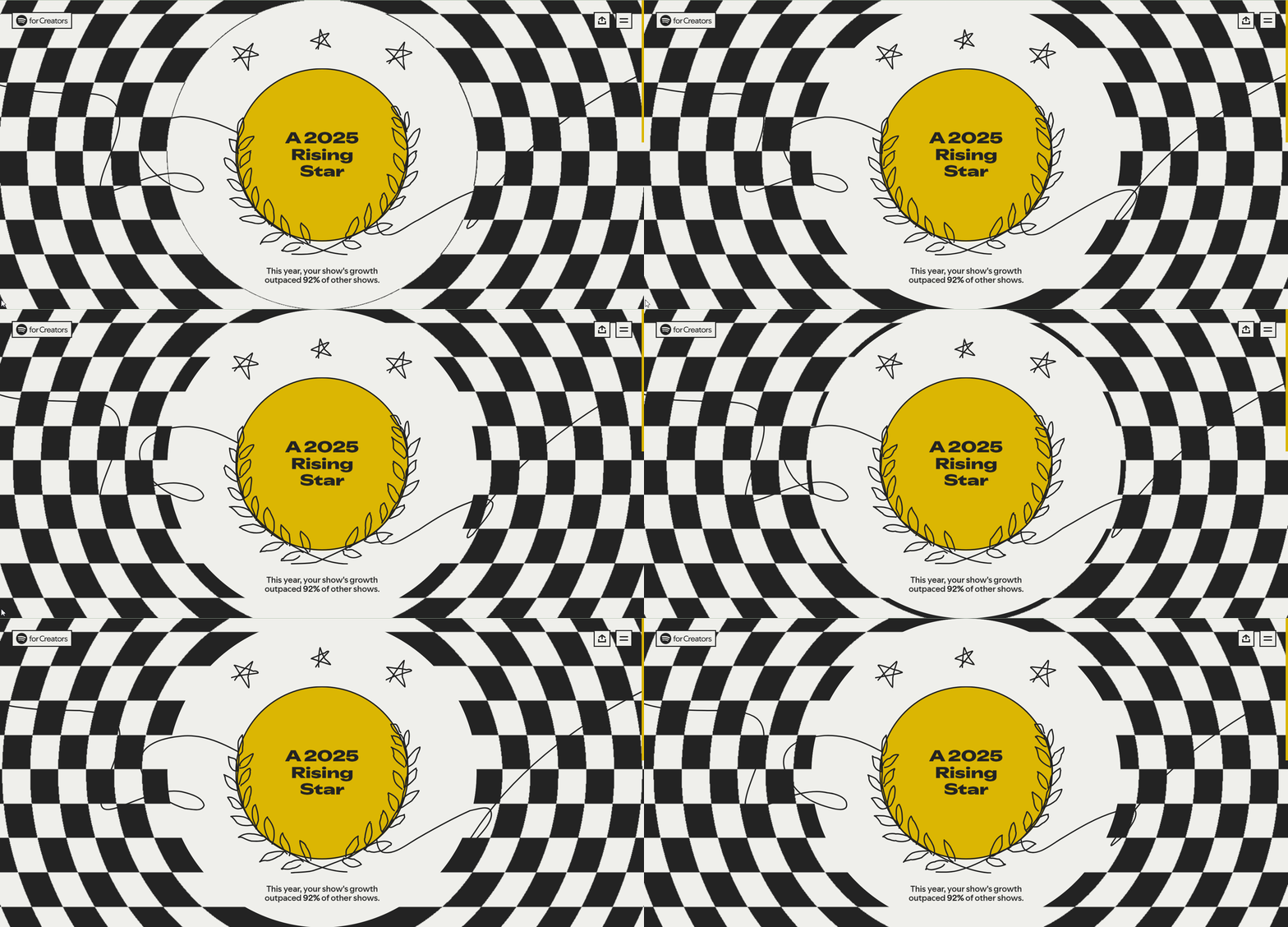
Before you get excited about this, my ‘Rising Star’ growth took me from (no joke) about 7 listeners per week to about 85 listeners per week. Thanks for the ego stroking, Spotify!
Thing is, a podcast is a huge time commitment. I chatted to a creator the other day who has a podcast with his Substack publication. It takes him 6 to 8 hours to make one episode. That’s a whole day of work each week!
The time commitment would be worth it if the podcast could generate serious income - or impact, for those creators who are not here for the dollars.
I’m telling you, it probably won’t.
Let’s run the numbers on my food safety publication and its podcast.
My primary goal for that publication is income.
My conversion rate is 6% - that is, for every 100 people who join my subscriber list, 6 of them become paying subscribers. Each paying subscriber pays $100 per year, and most stick around for 3 years.
So every 100 new subscribers is worth $1,800 (6 people x $100 x 3 years) and every 1 new free subscriber is worth $18 to me.
If I get one free subscriber from every podcast episode, I earn $18 per episode.
$18 earned per episode? Hmmmm.
Here’s why a podcast might be right for you
I’ve just shown you that it doesn’t make financial sense for me to do a podcast, even though my newsletter numbers are good (high conversion rate, high subscription fees, high retention rate).
Why do it? Because it improves the quality of my weekly newsletter - every week I discover and correct omissions and errors as I record the podcast, and since my readers are very detail-focused people, that gives me more superfans who refer my newsletter to all their colleagues for free1.
This approach only makes sense because it’s ultra easy for me to make each episode, taking just 25 to 40 minutes per week with no special equipment.
So a podcast can be worth it. But only if it gets you more of what you want AND doesn’t take you too much time or money to produce. This is where 98% of podcasts fail.
Most creators spend way too much time and way too much money trying to achieve their podcast goals. If each episode took me 6 hours and only earned $18, I would be on a losing ticket (and a fast track to burnout).
But if you can buck the trend and produce a podcast without spending hours of time and buckets of money, then a podcast might just be worth it for you.
Warning: Podcast experts want you to think podcasting is hard and expensive. They don’t want you to make your episodes quickly and cheaply because then they can’t sell you expensive hardware and trainings.
My simple podcast system
You’ve already heard that quick and cheap-to-make shows are the only podcasts that make sense for most creators. Now, find out how to podcast with Substack with my low-effort, low-cost system.
Step 1. Pick a simple format
Make your podcast short in duration. Avoid the interview format (because it takes too much time to find guests, set up sessions, deal with their tech problems and edit their rambling thoughts).
Simplest option: Record an audio version of your most recent post, or read out and expand on a recent post.
Why this works: All good podcasts are either heavily scripted or heavily edited. If you use your post as a script, you can do less editing, and you won’t have to write a script.
Remember, some people like to listen, some people prefer to read, but most people don’t do both, so there is no need to create different content for text and audio.
Pitfall: Avoid off-the-cuff riffing because the end result will either be (a) disjointed and boring or (b) need a lot of editing to make it good. Editing takes hours: avoid it at all costs.
Step 2. Record without fuss
Record straight into your laptop with a basic USB mic in a quiet room. There is no need for a fancy setup.
Hot tip: Sit with your head inside the wardrobe to reduce echoey sounds and background noises.
Step 3. Aim for zero edits
Editing takes time and effort. A lot of time. Avoid edits by self-correcting on the fly as much as possible (“Apologies, I should have said Y instead of X”).
Why this works: Your listeners are there to hear your voice; they don’t care about occasional imperfections. In fact, they might love you more for it. One creator I know even introduces his voiceovers by saying, “I’m attempting to record this in one take, so apologies for any bloopers”.
Hot tip: If you make a major mistake and know it will need to be edited, don’t stop recording. Instead, take a long pause, then clap your hands before restarting. The long pause and clap are easy to see on the visual display when editing, so you can jump straight to your mistake without having to listen to the whole file.
Step 4. Automate the intro and outro
Intros and outros add polish to any podcast episode, but manually adding them takes time and effort. The solution is automation.
Simplest option: I use Auphonic.com to add an intro to each episode. The Auphonic production engine also levels the volume, removes background noise, adds a copyright notice and backs up files to Google Drive automatically.
Hot tip: Buy a royalty-free jingle for your intro to avoid licensing issues. Short clips from AudioJungle cost under $5.
Step 5. Upload to Substack
Open an audio post in Substack, drop your file in, and press publish.
This is the magic part: When you publish a podcast episode, Substack will automatically distribute it to Apple Podcasts, Spotify and other major podcast apps via an RSS feed.
Hot tip: Keep the show notes simple, most listeners don’t read them anyway! But do include a link to your newsletter, of course.
Final thoughts
Most creators won’t get a good return on their investment from a podcast.
Podcasts aren’t as good for discovery as the experts might have you believe, and converting podcast listeners into Substack readers is much harder than you might think.
But they can be a lovely value-add to an existing publication, helping you deepen the connection and trust between you and your readers. And - for me at least - a podcast can provide an excellent pre-publish quality check on detailed long-form posts for pedantic audiences.
Podcasts only make sense if you can get dozens of new subscribers each episode (and to be honest, you probably won’t) OR if you can produce them with minimal time and cost.
So before you jump on the podcasting bandwagon, check your goals to see whether the time spent on a podcast will actually help you reach them. You might discover that launching a podcast because “everyone else is doing it” is a terrible idea.
And remember, there’s an entire industry of podcast gurus who need creators to believe that podcasts are fantastic growth tools as well as being difficult and expensive, so that they can profit by selling you tools and trainings.
That’s it from me this week, see you in the comments!
Karen
P.S. If you want a personal guided tour through my food safety publication, its podcast and the exact tools I use to make $26K per year in paid subscriptions from that publication, book a one-hour Zoom session with me ($249) and get an all-areas backstage pass with unlimited Q and A. Book your slot here.
I also use excerpts from my podcast for audiograms on YouTube, but that’s a story for another day.
"The honest truth about podcasts is that 98% of creators don’t need one.
"Actually, it’s worse than that. Not only do most creators not need a podcast, but most creators will end up wasting time and money on a podcast."
I'm convinced you are the most honest person on Substack, and reading your posts is always a special pleasure.
Thank you!! 🙏
Thank you for this! I’ve always been someone who connects more through listening than watching; there’s just something about audio that feels more personal and immersive. I recently started an audio-only podcast for that reason. Video works well for many people, but for my work and the kind of space I want to create, audio feels like the right fit. Plus, I enjoy doing it!